Customer Journey Clarity: Why Businesses Lose Customers
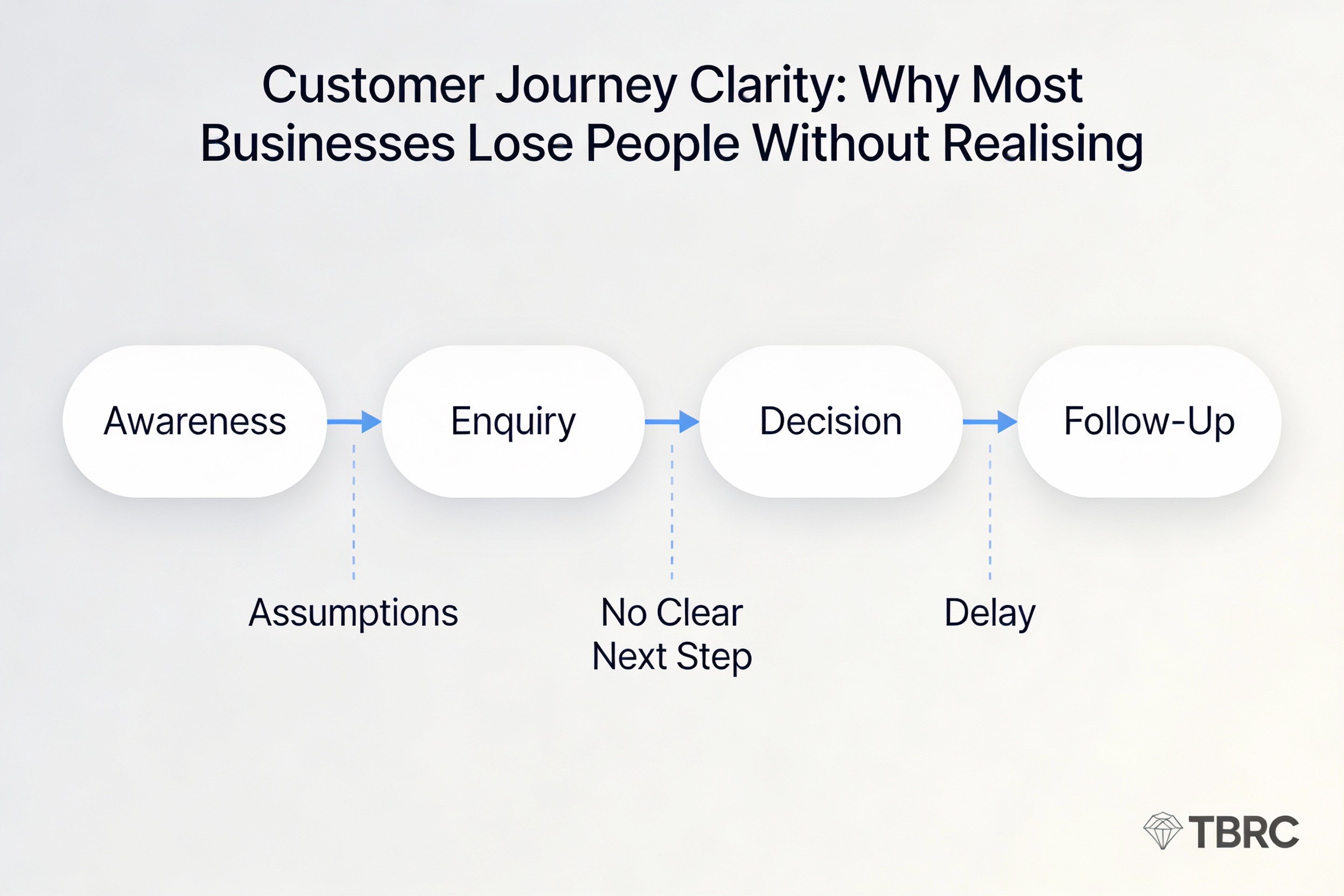
Customer Journey Clarity: Why Most Businesses Lose People Without Realising

Most business owners believe they understand their customer journey.
They know where enquiries come from.
They know how customers usually get in touch.
They know what happens once someone becomes a client.
And yet… things still feel messy.
Enquiries don’t always convert.
Good conversations don’t always lead anywhere.
Follow-up feels reactive instead of reliable.
That’s usually not because the business doesn’t care about customers.
It’s because the customer journey hasn’t been designed — it’s been inherited.
What a Customer Journey Actually Is (In Plain English)
A customer journey isn’t:
A funnel diagram
A CRM pipeline
A marketing buzzword
It’s simply the experience someone goes through from first awareness to final decision — including all the pauses, doubts, and assumptions in between.
And this is the part most businesses miss:
Customers don’t move in straight lines.
They move through uncertainty.
If the journey doesn’t guide them clearly, they don’t complain — they drift.
Where Journeys Break (Quietly)
Most customer journeys don’t fail at the obvious points.
They fail in the gaps.
The gaps between:
Seeing your business and understanding who you help
Making an enquiry and knowing what happens next
Receiving information and feeling confident enough to decide
From the business side, everything feels logical.
From the customer side, it often feels unclear.
And when people are unsure, they pause.
Pauses are where momentum disappears.
“We Give Great Service” Isn’t the Same as Journey Clarity
This is an important distinction.
Many businesses pride themselves on:
Being responsive
Being helpful
Doing good work
All of that matters — but it usually happens after a decision is made.
Journey clarity is about what happens before commitment.
Before trust is fully formed.
Before confidence is solid.
Before the customer feels safe choosing you.
Great service doesn’t fix a confusing journey.
Structure does.
Awareness Is Not Readiness
Another common assumption:
“If someone’s found us, they must be ready.”
Often, they’re not.
They’re:
Comparing options
Looking for reassurance
Trying to understand risk
Wondering what happens next
If your journey doesn’t meet them at that stage — with clarity, not pressure — they don’t move forward.
Not because they’re uninterested.
Because they’re unconvinced.
Why This Matters More Than Marketing
When a customer journey isn’t clear, businesses often respond by doing more:
More posts.
More ads.
More effort.
But attention without guidance doesn’t convert.
That’s why enquiry volumes and outcomes don’t always match effort levels.
It’s not that marketing “isn’t working”.
It’s that the journey isn’t doing its job.
Clarity Comes from Seeing the Journey as a Whole
Most business owners only ever see their journey from the inside.
What’s often missing is the outside view:
Where confusion appears
Where assumptions are made
Where silence creates doubt
Once you can see the journey clearly, fixing it becomes practical — not overwhelming.
A Simple Way to Get That Clarity
If you want to understand your customer journey properly — without guessing — the Customer Journey / Enquiry Gap Diagnostic is designed to do exactly that.
It helps you see:
Where people drop off
Where clarity is missing
Where structure would stabilise results
No pitch.
No pressure.
Just visibility.
