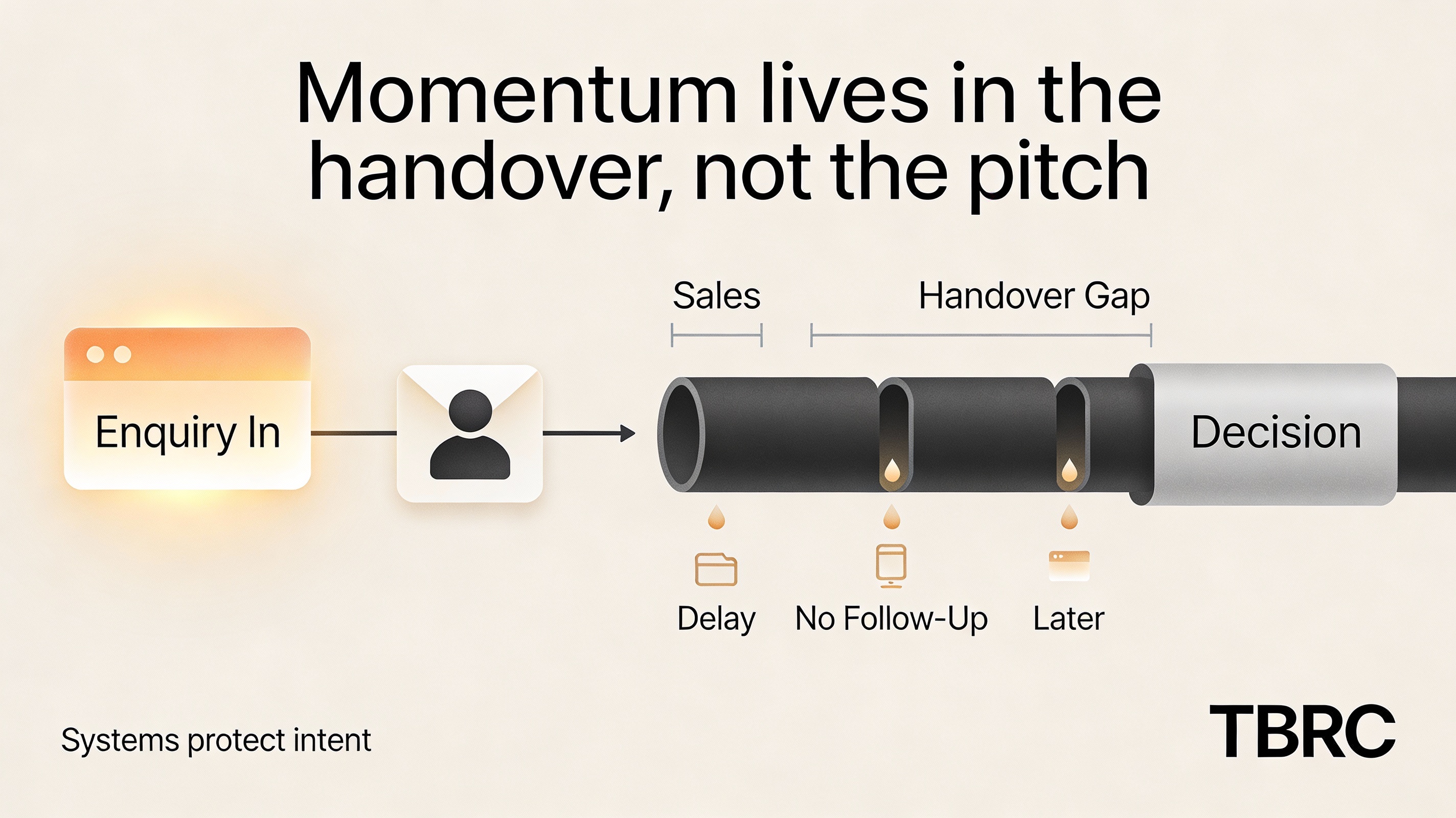
Why Leads Leak After Enquiries (And How to Stop It)
Why Leads Leak After They Enquire (And Why It’s Not a Sales Problem)

When leads don’t turn into customers, the instinctive reaction is often the same:
“They weren’t serious.”
“Price must’ve been the issue.”
“We need better quality leads.”
Sometimes that’s true.
But more often, leads don’t disappear because of sales ability or pricing.
They leak because nothing is protecting the moment after interest is shown.
And that’s a structural problem — not a people problem.
The Most Valuable Moment Is the One Least Protected
When someone enquires, they’re rarely ready to buy.
They’re usually:
Testing the waters
Looking for reassurance
Checking responsiveness
Trying to reduce risk
This moment is emotionally fragile.
If the journey doesn’t guide them clearly and quickly, uncertainty creeps in.
And uncertainty doesn’t create objections — it creates silence.
Where Lead Leakage Actually Happens
Most lead leakage doesn’t happen at the start.
It happens after:
The enquiry is sent
The first reply goes out
A quote or message is delivered
From the business side, things feel “done”.
From the customer’s side, things feel unfinished.
Questions remain:
What happens next?
When will I hear back?
Am I being considered properly?
Should I chase… or wait?
If the journey doesn’t answer those questions, momentum fades.
Why “We’ll Follow Up Later” Costs More Than You Think
Follow-up is where most revenue is quietly lost.
Not because people don’t care — but because follow-up often relies on:
Memory
Spare time
“When things calm down”
And they rarely do.
Time gaps feel small internally.
They feel much bigger externally.
Every delay introduces doubt.
Every doubt weakens intent.
That’s how interested leads turn into lost opportunities without ever saying no.
This Isn’t About Pushing Harder
There’s a common fear around follow-up:
“I don’t want to seem pushy.”
But clarity doesn’t feel pushy.
Silence does.
Most customers don’t want pressure — they want reassurance.
They want to know:
They haven’t been forgotten
Someone is in control of the process
There’s a clear next step
That reassurance comes from structure, not persuasion.
Lead Leakage Is a Handover Problem
In many businesses, leads move between:
Website → inbox
Inbox → person
Person → memory
Each handover is a risk point.
Without a defined system:
Ownership becomes unclear
Follow-up becomes inconsistent
Accountability disappears
Good intentions don’t survive busy environments.
Systems do.
Why This Feels Like a Sales Issue (But Isn’t)
From the outside, lead leakage looks like:
Poor conversion
Weak sales
Low commitment from customers
In reality, it’s usually:
Missing steps
Unclear expectations
Unprotected momentum
Once the journey is structured, conversion improves without changing the offer, pricing, or team.
That’s why this is such a high-leverage fix.
Seeing Where Leads Are Leaking
Most businesses never actually see where leads drop out.
They feel it — but they don’t map it.
That’s what the Customer Journey / Enquiry Gap Diagnostic is designed to uncover.
It helps you see:
Where leads lose momentum
Where follow-up breaks down
Where structure would stabilise outcomes
No blame.
No pressure.
Just clarity.
👉 [Enquiry Gap Diagnostic]
Leads don’t leak because your business isn’t good enough.
They leak because the moment after interest isn’t protected.
Once it is, results stop feeling unpredictable.
