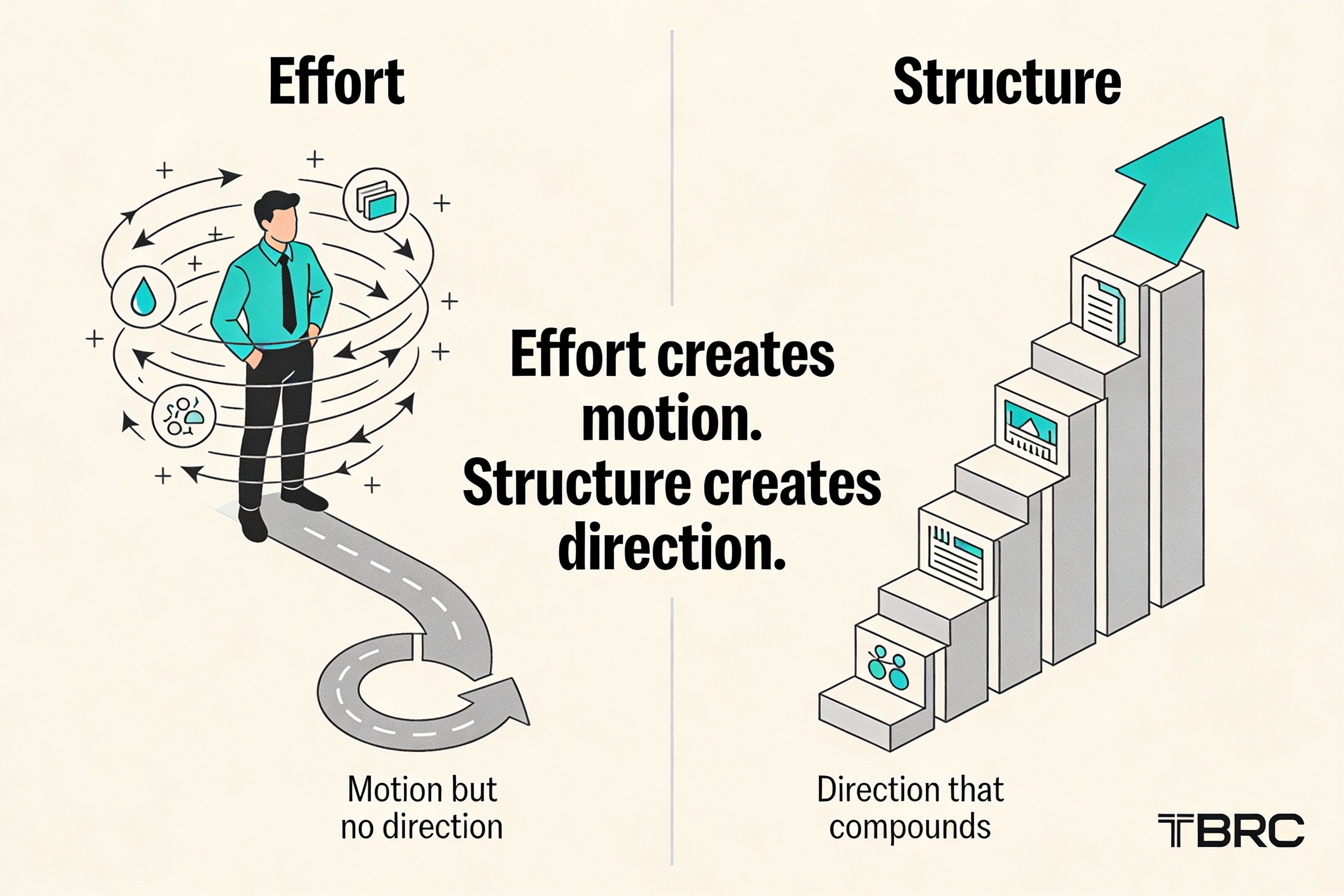
Why Effort Doesn’t Equal Progress in Business
Why Effort ≠ Progress (And Never Has)

Most business owners don’t struggle with effort.
They work long hours.
They solve problems daily.
They care deeply about doing things properly.
And yet progress often feels slow, uneven, or unpredictable.
That disconnect is frustrating — because it feels like effort should equal results.
But in business, it rarely does.
Not because effort isn’t important.
But because effort alone doesn’t compound.
Why Working Hard Often Feels Unsatisfying
Effort creates motion.
You answer emails.
You deal with issues.
You tick things off.
You stay busy.
But motion isn’t the same as direction.
Without a clear structure underneath it, effort gets absorbed by:
Firefighting
Reacting
Context switching
Repeating the same decisions
At the end of the week, you’re tired — but unclear on what actually moved the business forward.
That’s not laziness.
That’s friction.
Progress Needs a Shape
Progress only happens when effort has:
A sequence
A rhythm
A clear destination
Otherwise, energy disperses.
This is why two businesses can work equally hard — and only one feels like it’s moving.
The difference isn’t talent.
It’s design.
Why Motivation Isn’t the Answer
When progress stalls, the common advice is:
“You just need to be more consistent.”
But consistency doesn’t come from motivation.
Motivation is unreliable.
Some days you have energy.
Some days you don’t.
Some weeks are consumed by urgent problems.
If progress depends on how motivated you feel, results will always fluctuate.
Structure removes that dependency.
It decides in advance what matters — so you don’t have to decide every day.
Busy Is Often a Sign of Missing Structure
This is an uncomfortable truth.
Busyness usually increases when:
Priorities aren’t clear
Processes aren’t defined
Decisions aren’t protected
You work harder to compensate.
From the outside, it looks productive.
From the inside, it feels draining.
That’s why so many capable business owners say:
“I’m doing loads — but it’s not compounding.”
Effort is there.
Progress isn’t.
What Actually Turns Effort Into Progress
Progress comes from repeatable actions.
Not heroic bursts.
Not occasional focus.
But small things done consistently because the system demands them — not because you remembered.
This includes:
Clear weekly priorities
Defined follow-up
Protected decision paths
Fewer, better actions
When structure exists, effort finally sticks.
Why This Matters More Than Hustle Advice
Most hustle culture assumes:
More energy = more results
More hours = more growth
But most business problems aren’t solved by trying harder.
They’re solved by trying once, then designing the system so it doesn’t rely on willpower again.
That’s when effort starts compounding quietly — without burnout.
A Practical Way to Reframe Progress
If you’ve ever felt:
Busy but unsatisfied
Productive but unclear
Active but inconsistent
That’s not a personal failing.
It’s a signal that structure is missing.
The 90-Day Revival Plan exists to help turn effort into momentum by:
Clarifying priorities
Establishing rhythm
Reducing daily decision fatigue
It’s not about doing more.
It’s about making effort count.
👉 [Download the 90-Day Revival Plan]
Effort starts things.
Structure finishes them.
